

Early multilingualism means regularly exposing a young child to several languages from the first months of life. In Luxembourg, where French, Luxembourgish and German coexist in daily life, this is a widespread reality. Early childhood professionals observe that children exposed to multiple languages in a stable and reassuring environment develop their language skills without lasting confusion — at their own pace.
Every child has their own sensitivity, habits, rhythm and way of discovering the world. That is why, at Les Petits Tournesols, we approach multilingualism with care, kindness and dialogue with families. A few simple reference points can help families experience this richness in a calm and natural way.
1. Multilingualism begins in everyday life
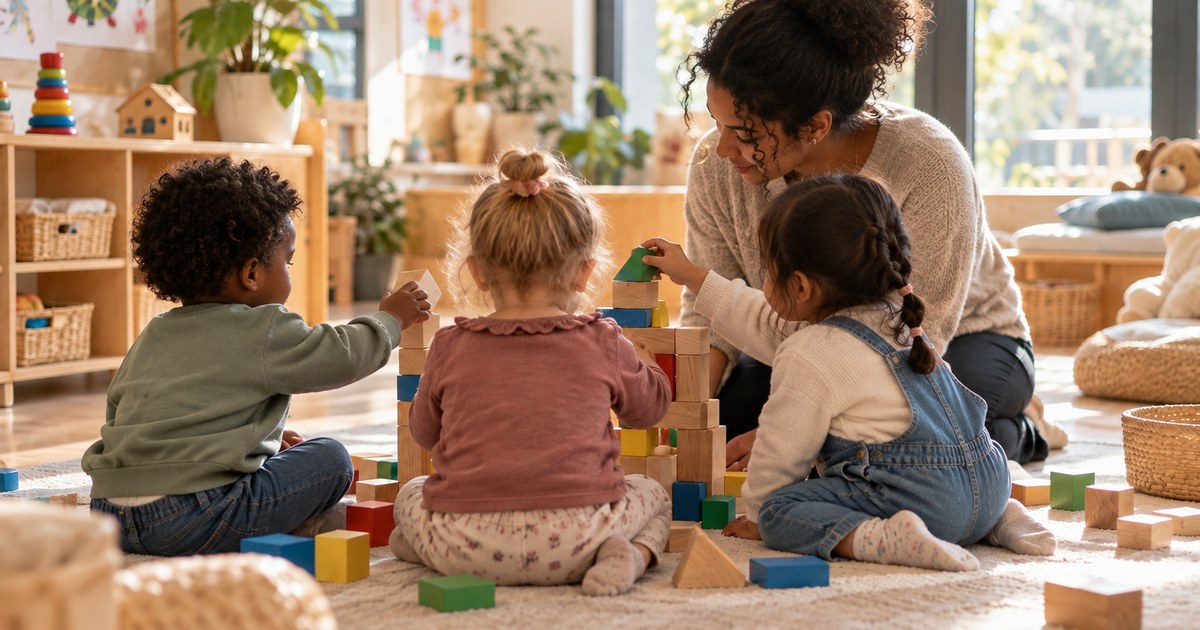
At Les Petits Tournesols, multilingualism is not experienced as something academic or rigid. It is built through simple moments: the morning welcome, play, songs, books, meals and everyday exchanges with the team and the other children.
A very young child does not first learn languages through rules. They discover them through repetition, routines, emotional connection and everyday interactions. This is what allows multilingualism to be lived in a calm and natural way.
2. Hearing several languages does not necessarily confuse a child
This is one of the questions parents ask most often. In reality, hearing several languages is not, in itself, a problem for a young child. Each child develops at their own pace, and it is perfectly normal for some children to understand a language before they begin to speak it.
It is also normal for a child to mix a few words from different languages from time to time. This can simply be part of a natural multilingual development.
3. The home language remains very important
Speaking to your child in the language in which you feel most natural remains essential. A rich and emotionally meaningful family language helps children build their reference points, their confidence and their communication foundations.
At Les Petits Tournesols, we see multilingualism as a way of building bridges between the different languages that are part of a child’s life, rather than replacing the family language.
What parents often ask us
- Could my child feel lost with several languages?
- Should I stop speaking my mother tongue at home?
- Is it normal if my child understands a language but does not speak it yet?
- Is it a problem if my child sometimes mixes a few words?
- How does the Les Petits Tournesols team support multilingualism every day?
4. In Luxembourg, multilingualism is part of everyday life
In Luxembourg, multilingualism is part of the daily reality of many families and many children. This makes it even more important to approach languages in a simple, reassuring and respectful way from the earliest years.
At Les Petits Tournesols, this means offering a calm and welcoming environment in which children can hear, discover and gradually become familiar with different languages through everyday life.
5. The most important thing is a reassuring environment
A very young child learns better when they feel safe. The quality of the relationship, the stability of the welcome, kindness and everyday routines matter more than any rigid method. Multilingualism should never become a source of pressure.
At Les Petits Tournesols, we favour a lively, human and soothing approach. Languages are discovered through connection, listening and real everyday experiences.
A simple checklist for parents
- Speak to your child in the language in which you feel most natural
- Do not aim for perfection: consistency matters more than performance
- Accept that your child may understand before speaking
- Do not worry if they sometimes mix a few words
- Value all the languages that are part of their life
- Talk with the Les Petits Tournesols team about the languages used at home
6. Every child develops at their own pace
Some children speak early, while others take more time. Some understand a great deal before they begin to express themselves. What matters most is not speed, but the quality of the child’s overall development and the consistency of the environment around them.
At Les Petits Tournesols, we encourage families not to compare children with one another. What matters most is observing each child as they are, with patience and confidence.
What to avoid
- Thinking that the home language should be removed to favour another one
- Comparing your child’s language development with that of other children
- Worrying too quickly if your child understands before speaking
- Turning languages into pressure or performance
- Not discussing the family’s language habits with the Les Petits Tournesols team
In conclusion
Multilingualism in very young children is not built through pressure, but through trust, repetition and everyday life. Every child develops at their own pace. What matters most is offering a reassuring, coherent and language-rich environment.
At Les Petits Tournesols, we see multilingualism as a natural richness, lived simply and respectfully for each child and each family.
For any question, you can contact us.
Frequently asked questions
At what age can a child learn several languages at the same time?
From birth, children distinguish language sounds very early. Exposure to several languages in a stable emotional context can support development, especially when interactions are regular and natural.
My child mixes languages when speaking. Is that a problem?
No. Mixing languages is common in multilingual development. It usually decreases as the child progresses in each language.
Should I stop speaking my home language to help my child learn Luxembourgish?
No. Parents are encouraged to keep speaking the language that feels most natural and affectionate at home. A strong family language also supports other language learning.
Which languages are spoken at Les Petits Tournesols nurseries?
French and Luxembourgish are the main everyday languages in the three nurseries in Kayl, Itzig and Brouch. The team also adapts communication to the needs of children and families.
Is it normal if a child understands a language but does not speak it yet?
Yes. Understanding often comes before speaking. A child may understand a language for several months before starting to use it actively.
Is there a risk of language delay in a multilingual context?
Exposure to several languages does not in itself cause language delay. If concerns persist, it is best to speak with the child's doctor or a speech therapist.