
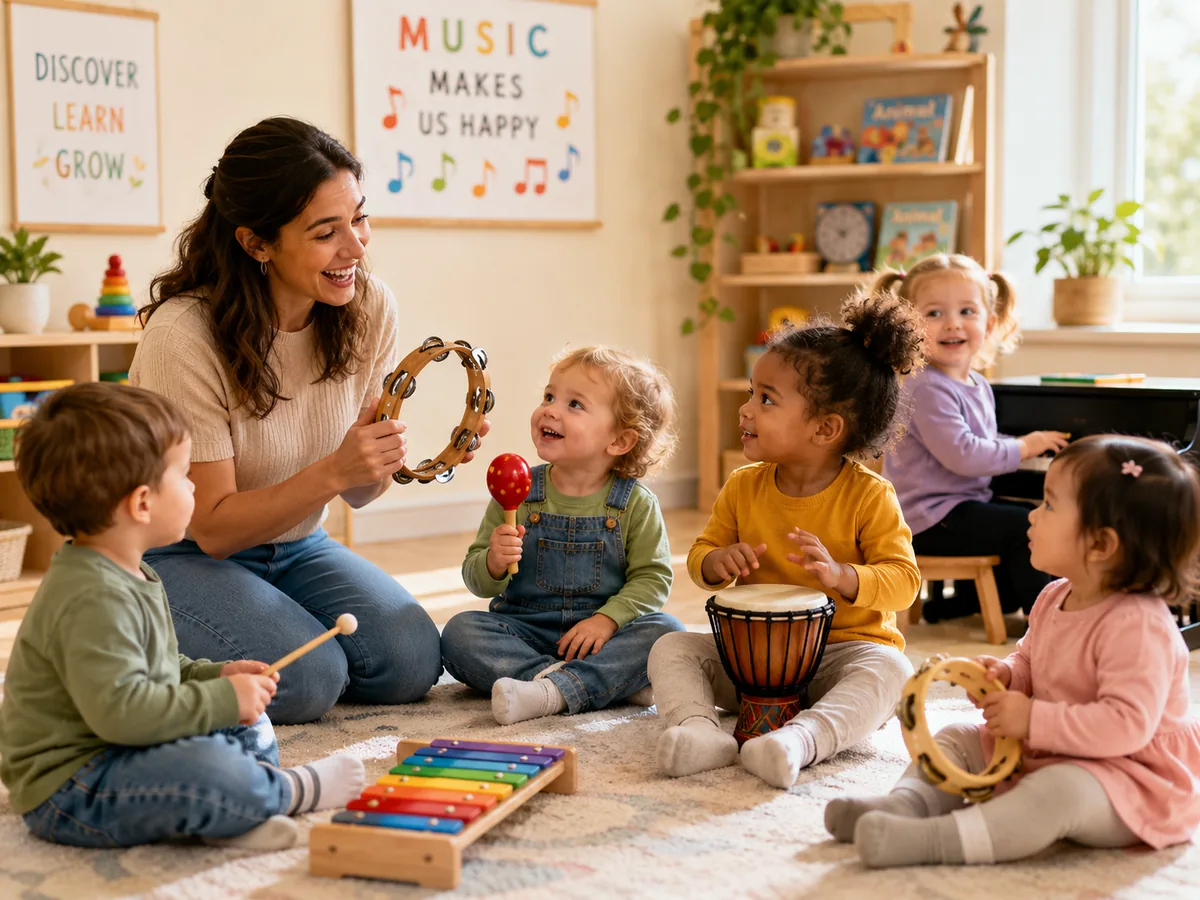
At nursery, music is not just a pleasant moment. It is a language before words, a way to gather, listen, wait for one's turn, move, dare and try again.
At Les Petits Tournesols, music workshops are part of those precious moments when children learn without feeling that they are learning. A drum touched softly, a maraca shaken, a song recognised: every detail matters.
Why offer music to very young children?
For young children, music first passes through the body. Before naming a rhythm, the child feels it. They clap their hands, sway their shoulders, walk, stop and start again. These experiences gradually build reference points: listening for a signal, following a pulse, coordinating a gesture.
Music also supports language. Repeated songs, rhymes and vocal games give children natural opportunities to hear syllables and intonations. In a multilingual nursery such as Les Petits Tournesols, it is a particularly rich tool: music allows children to enter a language without pressure, through pleasure and imitation.
Lively workshops adapted to each child's age
The workshops are designed to remain accessible to very young children. Children can observe, listen, touch, handle and try. Some join the activity straight away. Others prefer to watch before taking part. Both attitudes have value.
Musical awakening is not a performance. It is a gradual discovery: the child explores a sound, understands that a gesture produces an effect, tries again, adjusts and then shares the moment with the group.
Kid's Zik: a sensory journey around real instruments
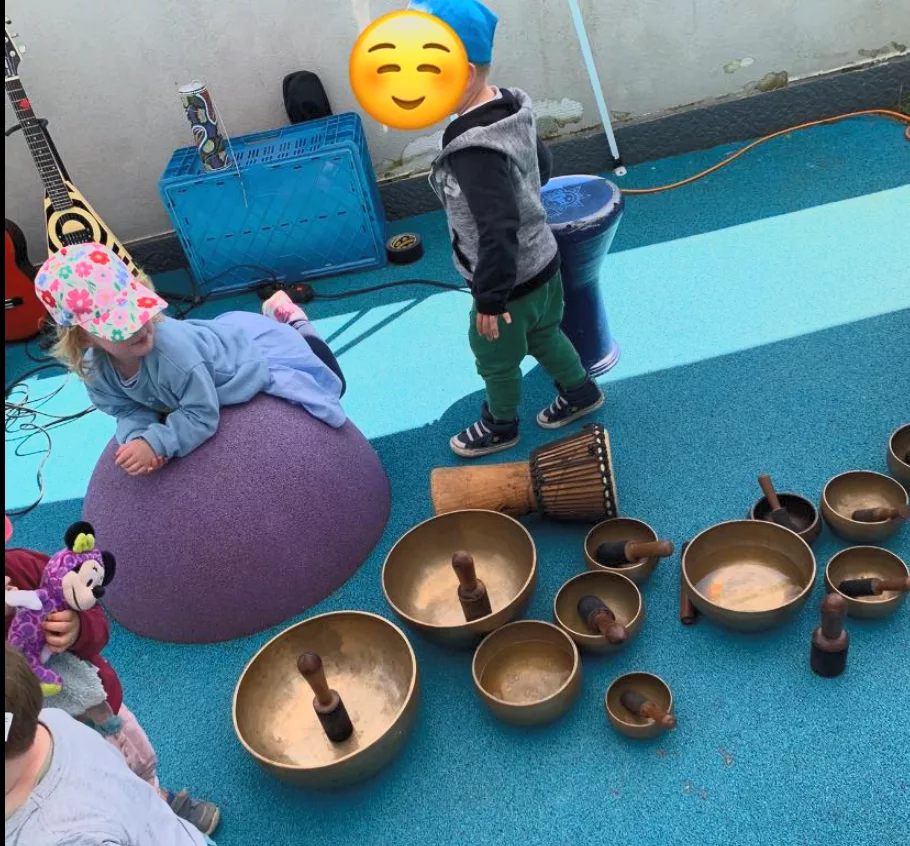
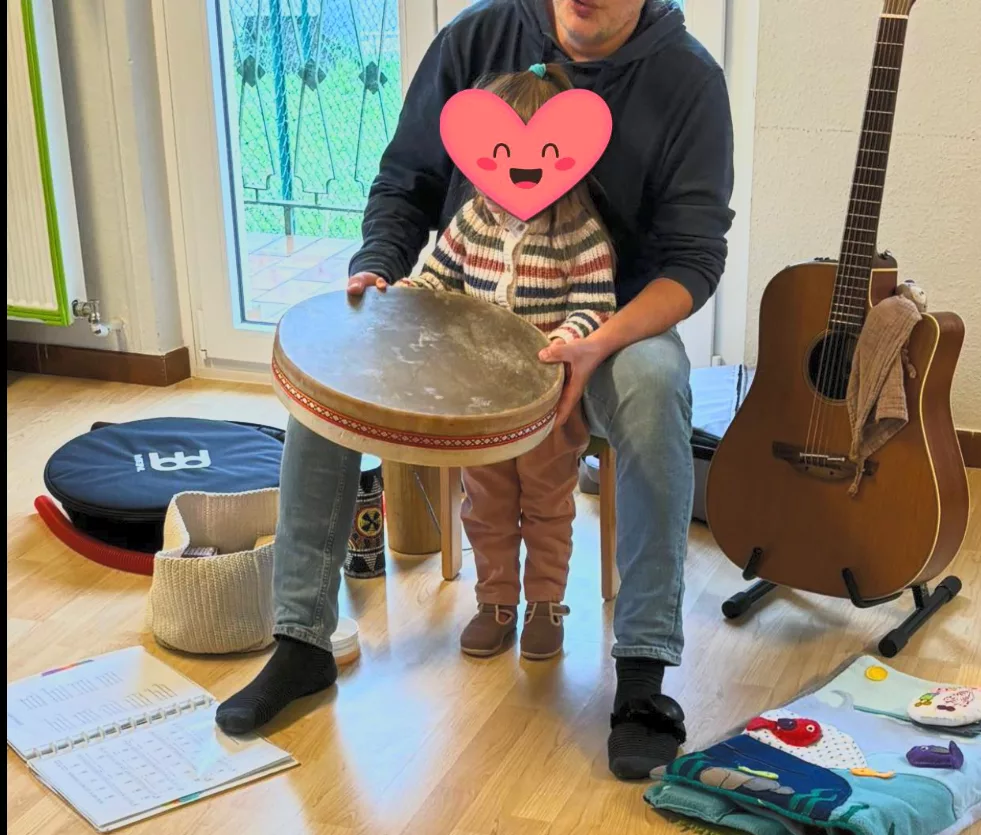
With Kid's Zik, Jean-Philip Buyl offers children a genuine moment of sensory discovery. His approach is based on a simple idea: allowing children to handle real instruments adapted to their size and abilities.
The sessions become small musical journeys. Children discover rhythmic instruments, wind instruments and instruments from other horizons. Everything is presented as play, so that discovery remains natural and joyful.
Guest practitioner: Jean-Philip Buyl - Kid's Zik
Trois petites notes de musique: sessions built like stories
Julien Mertz, with Trois petites notes de musique, offers structured work throughout the year. Children discover sessions organised around new themes, new instruments and songs chosen to support the world of each workshop.
His approach gives an important place to regularity. Each session brings something new within a recognisable framework. This continuity reassures children and helps them progress. The intervention sheets shared with the nursery allow parents to continue the experience at home.
Guest practitioner: Julien Mertz - Trois petites notes de musique
The team's view
For the Les Petits Tournesols team, music is part of everyday nursery life. It complements playtime, stories, outings and sensory activities.
In Brouch, Sandy, the nursery manager, has supported children's development for many years. Her view reflects that of the whole team: music often gives children a different way to participate. A reserved child can express themselves through a gesture. A very active child can channel their energy into a rhythm. Contact us to learn more about our educational project.
Frequently asked questions
Why offer musical awakening in nursery in Luxembourg?
Musical awakening helps young children listen, move, handle instruments, wait for their turn and take part in a group activity. It supports motor skills, language and emotional expression, without any performance goal.
From what age can a child take part in a music workshop?
Very young children can take part early. In nursery, a child can listen, observe, touch an instrument or simply stay close to the group. Participation develops gradually, at the child's own pace.
Do children handle real instruments?
Yes, when the instruments are adapted to their size and abilities. The guest practitioners offer rhythmic, wind or discovery instruments, always within a safe and supported setting.
Does music support language development in nursery?
Music can support language through songs, rhythms and voice games. It helps children hear sounds differently and enter words through pleasure, which is especially useful in a multilingual nursery.
How can parents continue musical awakening at home?
Singing, tapping a rhythm, listening to a familiar song or letting the child explore simple sounds is enough. The most important thing is not musical accuracy, but sharing the moment with the child.