

Choosing a nursery in Luxembourg involves checking several key criteria: the facility's ministerial accreditation, the clarity of its educational approach, the languages used, opening hours, capacity and the quality of the relationship with families. In Luxembourg, any nursery caring for young children must be accredited by the Ministry of Education, Children and Youth. This guide helps families ask the right questions, simply and without jargon.
After sixteen years of welcoming families in our daycares in Kayl, Itzig and Brouch, we keep hearing the same questions, always driven by the same caring wish to make the right choice. A good daycare is not just an available place in the right location. It is a place of daily life, routines, relationships and support — for the child as well as for the parents.
1. Start by clarifying your practical needs
Before visiting anything, take fifteen minutes to answer three simple questions. What are your real hours, from morning to evening? Opening times vary from one structure to another — some open at 6:30 a.m., others at 7:00 a.m. — and even half an hour can quickly become a source of daily stress.
What rhythm do you want for your child? Every day, a few half-days, or a flexible contract depending on the week? With the childcare service voucher reform planned for 2027, contracts are expected to move towards billing that reflects families’ real needs more closely. This makes it even more important to choose a structure that can adapt to your daily life rather than the other way around. Finally, how much distance are you ready to accept? In Luxembourg, morning traffic can weigh heavily on the day — a daycare close to home or work often means less fatigue for everyone.
2. Check that the structure is officially approved
This is non-negotiable. In Luxembourg, every serious childcare structure must hold a ministerial approval issued by the Ministry of Education, Children and Youth.
This approval means that the structure works within a defined framework in terms of staffing, premises and organisation. Without it, no public financial support through the childcare service voucher is possible — which makes a significant difference for families. A trustworthy structure communicates clearly on this point.
Quick summary
- Clarify your real hours, your budget and the distance you can realistically manage
- Check the ministerial approval before making any decision
- Make sure the structure accepts the childcare service voucher
- Look at the educational approach, the activities and the relationship with families
- Take team stability and daily communication into account
3. Read the educational approach — and what it says about daily life
An educational project is not just a presentation document. It reflects how a team thinks about welcoming a two-month-old baby or a three-year-old child every single day, through the small details of daily life: meals, naps, morning separation, calm moments, play and transitions.
In the non-formal education sector, structures working within the SEA framework must rely on a mandatory general action concept. You have every right to ask how the structure works in practice and what its educational priorities are. A good team will explain this clearly and simply.
4. Observe the relationship with parents
A quality daycare is also about a relationship of trust with the family — not only about welcoming the child. During your visit, observe how the team behaves with you: are things explained clearly? Do they listen? Are you given space to ask your questions without feeling rushed?
A very good sign is when the team naturally talks about the daily handover in the morning and evening, about how information is shared and how parents are supported in everyday life. In our daycares, we know that reassured parents also help their child live this step more calmly.
5. Take multilingual education into account
In Luxembourg, the structures concerned by the multilingual education programme provide exposure to Luxembourgish and French for children aged 1 to 4, while also valuing the languages spoken at home.
For many families, this is an important criterion. That does not mean your child must already speak several languages. What matters is understanding how this approach is lived in daily life, with naturalness, gentleness and coherence.
Useful questions to ask during a visit
- How does the settling-in period work, especially for a baby?
- How does the team communicate with parents every day?
- How are meals, sleep and calm moments organised?
- What is the structure’s educational approach?
- How is multilingualism lived in practice during activities?
- Do the children go outside regularly?
- How long have the educators been working there?
6. Also think about the practical reality of daily life
A daycare may look perfect on paper and still be difficult to manage in real life. Flexibility in case of illness, opening hours, distance, ease of access and the possibility of a progressive settling-in period are all very important elements.
Team stability also matters enormously. Young children build their emotional security through familiar faces, stable routines and predictable habits. The right choice is often the one that combines quality of care with lasting family balance.
7. Do not choose in a rush
In some areas, waiting lists can be long. When possible, it is better to start the process early enough. But the pressure to find a place should never replace your judgement.
Even a short visit tells you more than a website or an online form ever will: the sound atmosphere, the way the educators look at the children, the way you are welcomed at the door — all of that can be felt immediately. With 16 years of experience in early childhood, we know that parents often need a simple, human and practical conversation in order to make their choice with confidence.
What to avoid
- Choosing only based on proximity, without visiting
- Not checking the ministerial approval of the structure
- Ignoring the educational approach because it seems too administrative
- Forgetting to ask how the team communicates with parents
- Not looking into team stability and staff experience
- Deciding in a rush without clarifying your real needs
In conclusion
Choosing the right daycare in Luxembourg means finding the right balance between the child’s needs, the family’s expectations and the reality of daily life. The right choice is not only an available place: it is a structure where you can leave your child with confidence — and go to work with greater peace of mind.
Across our network of three family-run daycares in Kayl, Itzig and Brouch, we have been supporting families with clarity, kindness and transparency for 16 years. Our teams and our leadership remain available to answer your questions and organise a visit at your pace.
For any question, you can contact us.
Frequently asked questions
What is the difference between an approved and a non-approved nursery in Luxembourg?
In Luxembourg, a nursery approved by the Ministry of Education, Children and Youth meets defined standards for supervision, safety and its educational project. It also allows eligible families to benefit from the childcare service voucher.
Which languages are usually used in Luxembourg nurseries?
Many nurseries in Luxembourg offer multilingual care, with French and Luxembourgish among the common languages. It is best to check which languages are actually used day to day during a visit.
At what age can a child start nursery in Luxembourg?
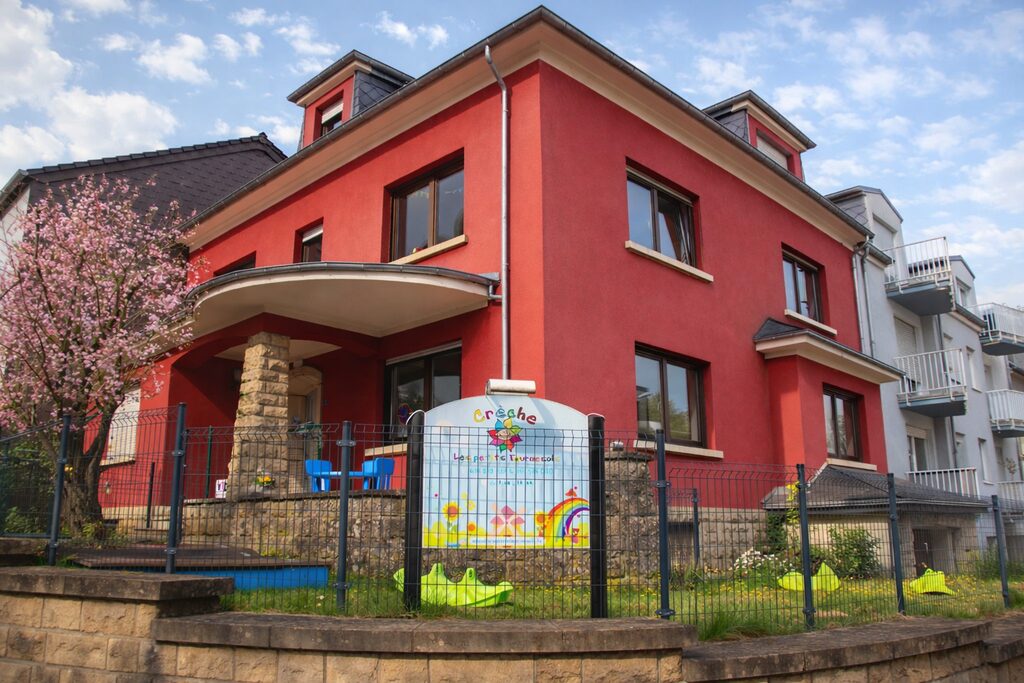
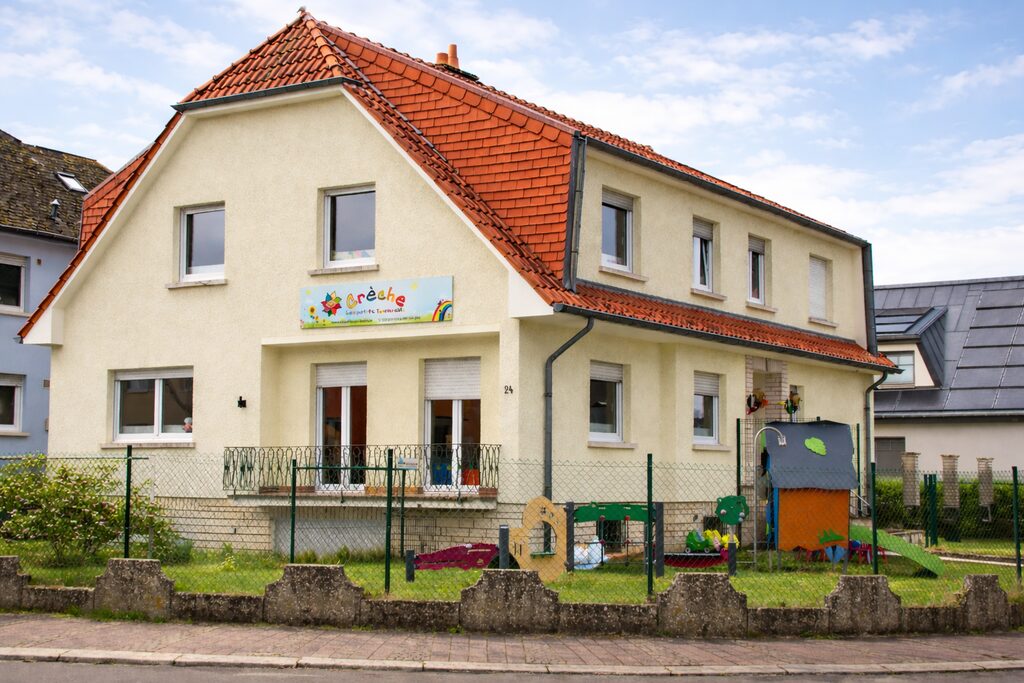
Many approved nurseries welcome children from 2 months to 4 years old. Les Petits Tournesols nurseries in Kayl, Itzig and Brouch welcome children in this age range.
How far in advance should families contact a nursery?
It is advisable to start the process several months before the desired start date. Availability varies according to the nursery, age group and period.
What should I ask during a nursery visit?
Ask about settling-in, languages spoken, communication with families, meal provider, proposed activities and how age groups are organised.
Can families visit Les Petits Tournesols before registration?
Yes. Interested families can contact the Kayl, Itzig or Brouch nursery directly to arrange a visit, depending on availability.
Are places available at Les Petits Tournesols nurseries?
Availability changes regularly. Check the available places page or contact the nursery of your choice for the current situation.